Scalduffing for nautical resins
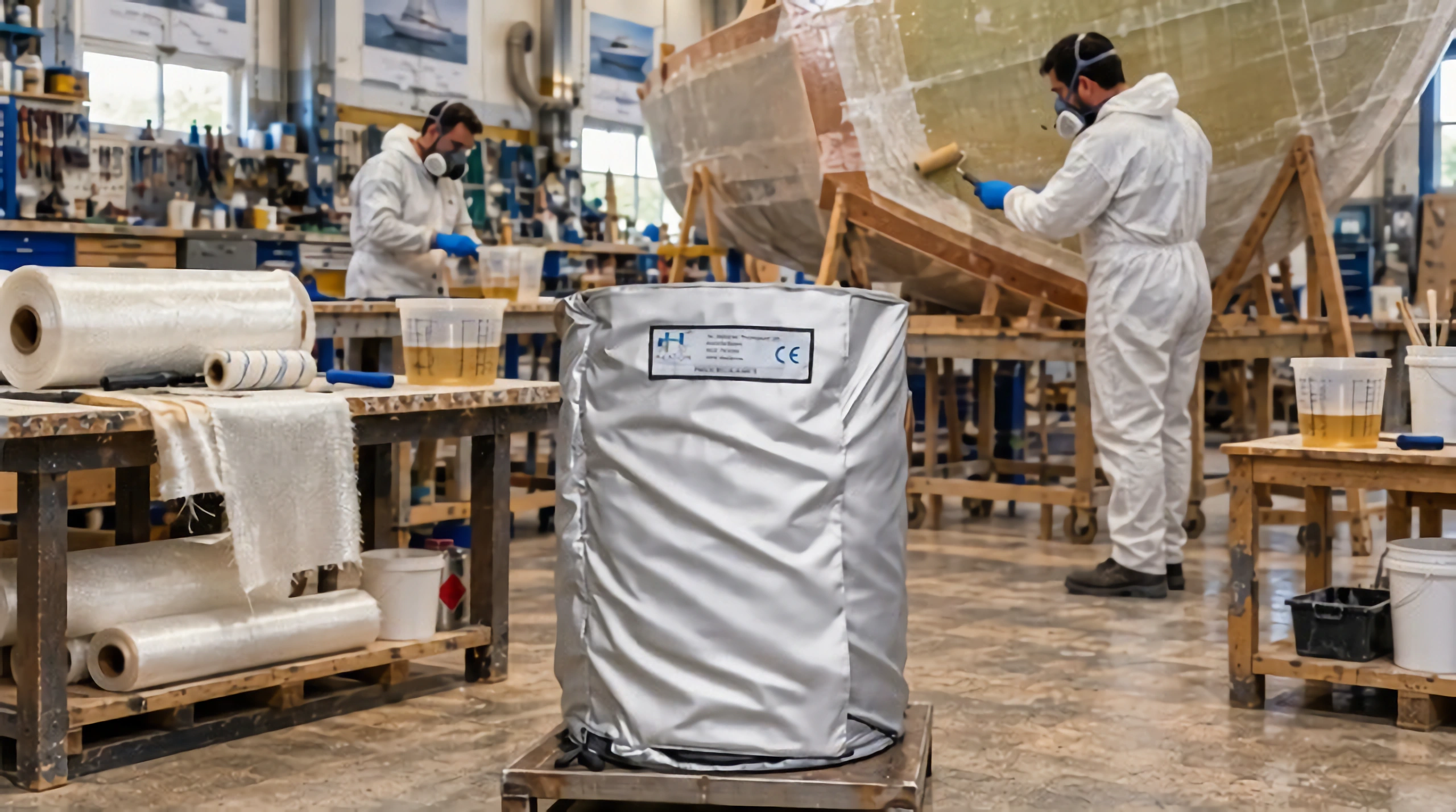
In a marine shipyard, the preparation of materials is an integral part of work organization. Epoxies, adhesives, sealants, and other products can become more viscous with cold temperatures, making it less convenient to pour from the barrel, to measure, and to transfer them to the working station.
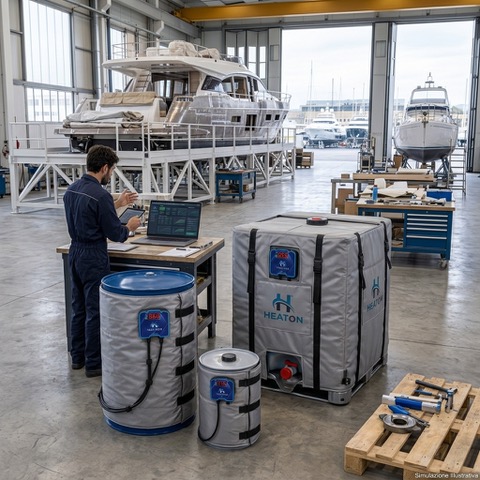
HeatOn develops insulated and configurable electric heating elements to heat or maintain the required temperature of the materials contained in compatible containers within the system.
Thermal insulation, the distribution of heating zones, control and regulation are defined according to the product and process. The goal is to organize the preparation of materials in a more predictable manner, reduce waste, and make the heating consistent with the actual needs of the construction site.
Fields of Application
- Epoxy resins: Preparation of the components before dosing and mixing, when the manufacturer allows thermal conditioning.
- Adhesives and sealants: temperature management to facilitate the collection and handling of compatible products.
- Materials for laminating and repairing: conditioning of materials used in the construction, maintenance and repair of marine components.
- Bottles and containers of various capacities: evaluation of configurations for containers of 25, 50 and 60 liters, 200-liter drums and IBC containers, after verifying compatibility.
- Planned preparation of materials: The possibility of evaluating control systems that allow the start of heating to be anticipated and the temperature to be monitored.
Heat up according to the amount of material
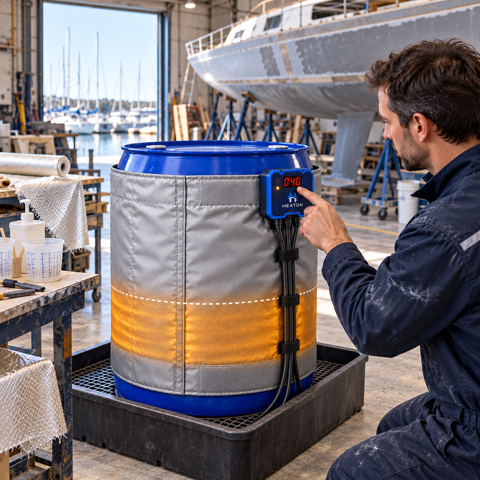
When the resin level drops, the container’s thermal requirement changes. In a partially empty tank, keeping all heating zones active can lead to unnecessary heating of the upper areas.
HeatOn multi-zone configurations can be designed to separately manage different portions of the stem. For example, when the product is predominantly occupied by the lower part, it is possible to consider a configuration that allows the lower zone to be activated while the upper one is deactivated.
The arrangement of the zones, their power, and the position of the sensors must be determined based on the geometry of the container, the level of the material, and the thermal behavior of the product.
The operating advantage: Adapt the heating to the operating conditions, avoiding unnecessary heating of non-required areas and favoring a more targeted use of energy. The actual savings depend on the configuration, the material and the usage cycle.
Prepare the materials before the start of the shift
If the heating starts only when workers arrive at the construction site, the material may not have yet reached the desired temperature at the time it is to be used.
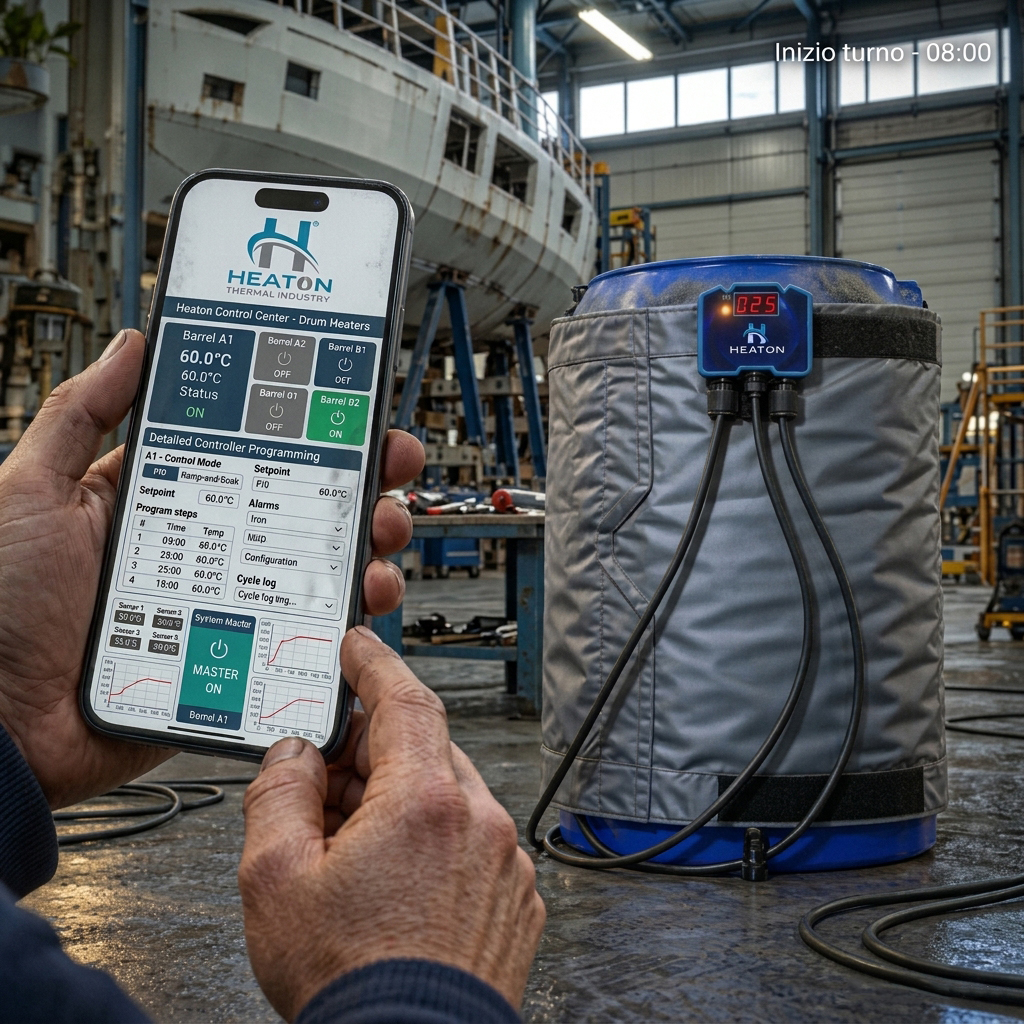
For configurations compatible with remote management, HeatOn can evaluate solutions that allow for the anticipation of ignition and the verification of the system status before the start of the process.
Programming must take into account the mass of the product, the initial temperature, the ambient temperature, the insulation and the available power. The time required to heat a 200-liter barrel, for example, cannot be deduced from the heater’s nominal power alone.
The operating advantage: Coordinate the preparation of materials with the work schedule and reduce the waiting times due to a late start, without assuming equal heating times for all products.
Thermal insulation to limit the dispersion
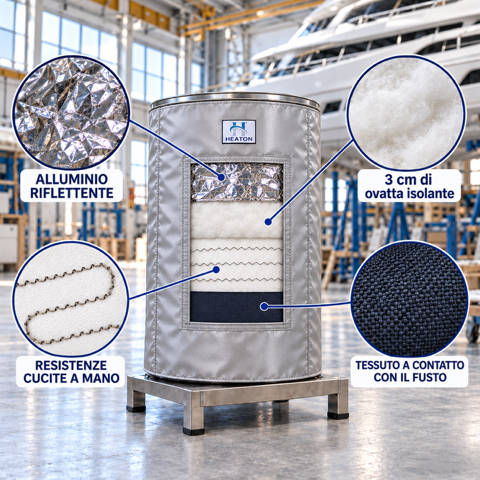
Part of the energy supplied to the container is dissipated into the environment. The extent of the dissipation depends on the temperature difference, the exposed surface, the insulation, the environmental conditions, and the presence of openings or thermal bridges.
HeatOn warming vests can integrate insulating linings, fixing systems and closures designed according to the container and the conditions of use.
Isolation helps to limit heat exchange with the environment during heating and maintenance. It does not eliminate dissipation, but can help reduce the energy required to compensate for it.
The operating advantage: Manage thermal maintenance more efficiently, especially when the material must remain available for extended periods.
A solution for the container and the material
A system designed for a 200-liter metal tank is not automatically suitable for a plastic container, a smaller container, or an IBC tank.
For this reason, HeatOn evaluates the characteristics of the container, the material it is made of, the geometry, the closing system, the level of filling and the conditions of use. The method of retrieval, the frequency of use and the quantity of product that must be available at the start of the shift are also considered.
The power, isolation, heating zones, sensors and the control system are then sized according to the specific application.
Before defining the configuration, it is necessary to check the product's technical and safety data sheet, the allowed temperatures, the compatibility of the container, and any requirements related to the working environment.
Technical characteristics
Power Density
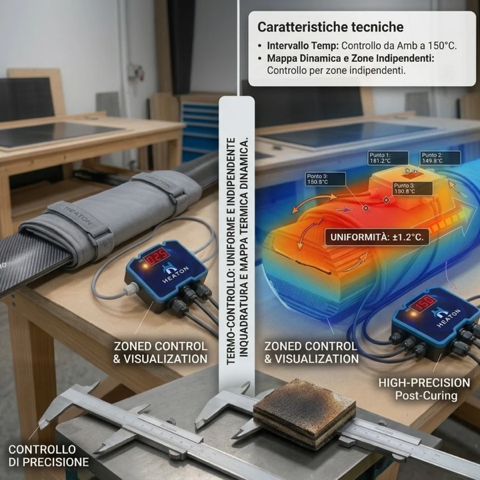
Power density from 100 to 500 W/m², selectable depending on the component, the thickness of the laminate and the characteristics of the resin. The sizing takes into account the required temperature and the operating conditions of the thermal cycle.
Temperature range
Temperature control from ambient to 150 °C, depending on the system configuration. The thermal control allows the heating to be managed according to the parameters required by the processing, including polymerization and post-curing cycles compatible with the materials used.
Nutrition
120, 230, 380Vac,
12, 24, 48Vcc
Types of Control
Basic control
Solution with mechanical thermostat for applications that require simple temperature adjustment and interventions with defined heating parameters.
Programmable digital control
Digital controllers that allow the thermal cycle to be programmed, with heating phases, temperature maintenance and possible controlled cooling, according to the functionality of the chosen configuration.
Smart/Wi-Fi control
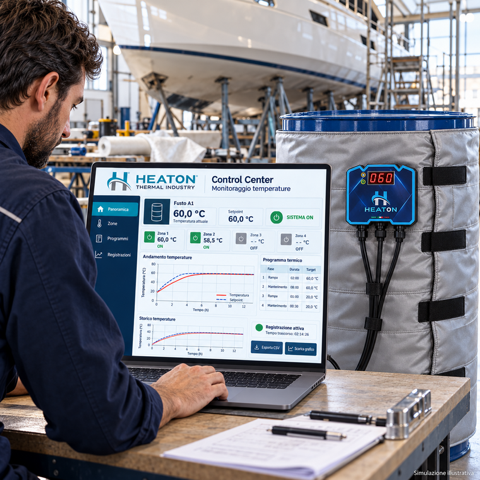
For compatible configurations, app management and remote monitoring of operating parameters, with possible alarm notifications.
Monitoring and recording of thermal cycles
The pre-configured configurations can enable the recording of process data and their integration into information systems. The available features depend on the control unit and the selected configuration.
Heating designed into the product
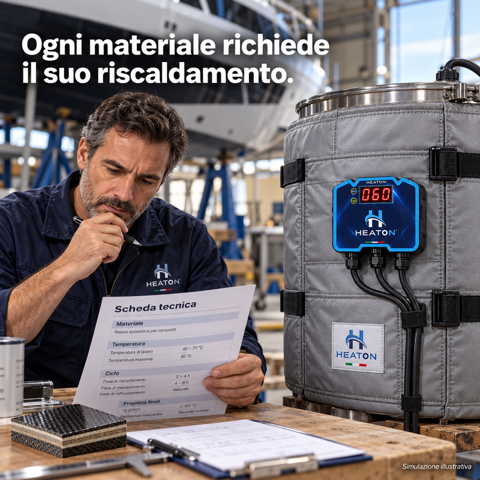
Heating should not be considered a universal solution for any resin or chemical substance.
Excessive temperatures can alter the material's characteristics, reduce its useful life, or create operating conditions not intended by the manufacturer. Some products may also require special precautions in the presence of flammable vapors or potentially explosive atmospheres.
For each application, it is therefore necessary to verify the maximum allowable temperature, the heating method, the compatibility of the contact materials, and the safety requirements of the application site. The configuration must also be chosen based on the environmental conditions and the applicable regulations.
HeatOn starts from this information to evaluate a solution that is consistent with the material, the container and the process.
💬 Tell us what you want to improve in your workshop
Do you want to have resins that are easier to remove at the beginning of the shift? Manage partially full tanks? Limit thermal dispersion or monitor the temperature during material preparation?
QUESTIONS AND ANSWERS FAQ
A: The viscosity of many epoxy resins increases with decreasing temperature. The material can therefore flow less easily, adhere more strongly to the walls of the container, and require more time for sampling and dosing. The extent of the change depends on the specific formulation.
A: There is no valid temperature for all resins. It is necessary to refer to the product's technical data sheet, distinguishing the storage temperature from the processing temperature and verifying any heating limits. The temperature must be compatible with the formulation and with the manufacturer's instructions.
A: It is possible to evaluate an individual heater sized for the container and the product contained. Power, heat distribution, insulation, sensors, and control must be chosen based on the initial temperature, the desired temperature, and the available time. It is not possible to determine the heating time by considering only the capacity of the container.
A: It depends on the amount of material, the initial temperature, the power actually transferred to the product, the insulation and the dissipation to the environment. To estimate the time, it is necessary to know at least the initial and final conditions and the thermal characteristics of the system.
A: It is possible to evaluate multi-zone systems with independent activation of the heating zones. This solution can be useful when the product level decreases during use. The arrangement of the zones and sensors must still be designed to ensure an adequate thermal distribution.
A: Feasibility depends on the material of the container, its maximum allowable temperature, the geometry and the heating system. Plastic drums and IBCs require specific verification of thermal and mechanical compatibility before choosing the solution.
A: Heating can affect the viscosity and reaction speed once the resin and curing agent are mixed. An increase in temperature can reduce the time required to apply the mixture and accelerate polymerization. It is therefore essential to follow the manufacturer’s instructions and not confuse conditioning the separate components with heating the mixture.
A: Yes, for configurations equipped with compatible remote management functions. The ability to pre-set the ignition and check the available parameters depends on the control unit and the system chosen. Programming must take into account the time required to reach the required temperature.
A: The pre-configured configurations can integrate monitoring and recording functions. However, to obtain data representative of the material, it is necessary to correctly define the positioning of the sensors and verify the difference between the surface temperature of the heating element, the container wall, and the contents. The recording functions depend on the control unit and configuration.
A: It is necessary to know the product, the technical and safety data sheet, the capacity and material of the container, the filling level, the required temperature, the available time, and the environmental conditions. Based on these data, it is possible to evaluate power, insulation, heating zones, control, and safety requirements.