Heating for repair of hulls and composite components
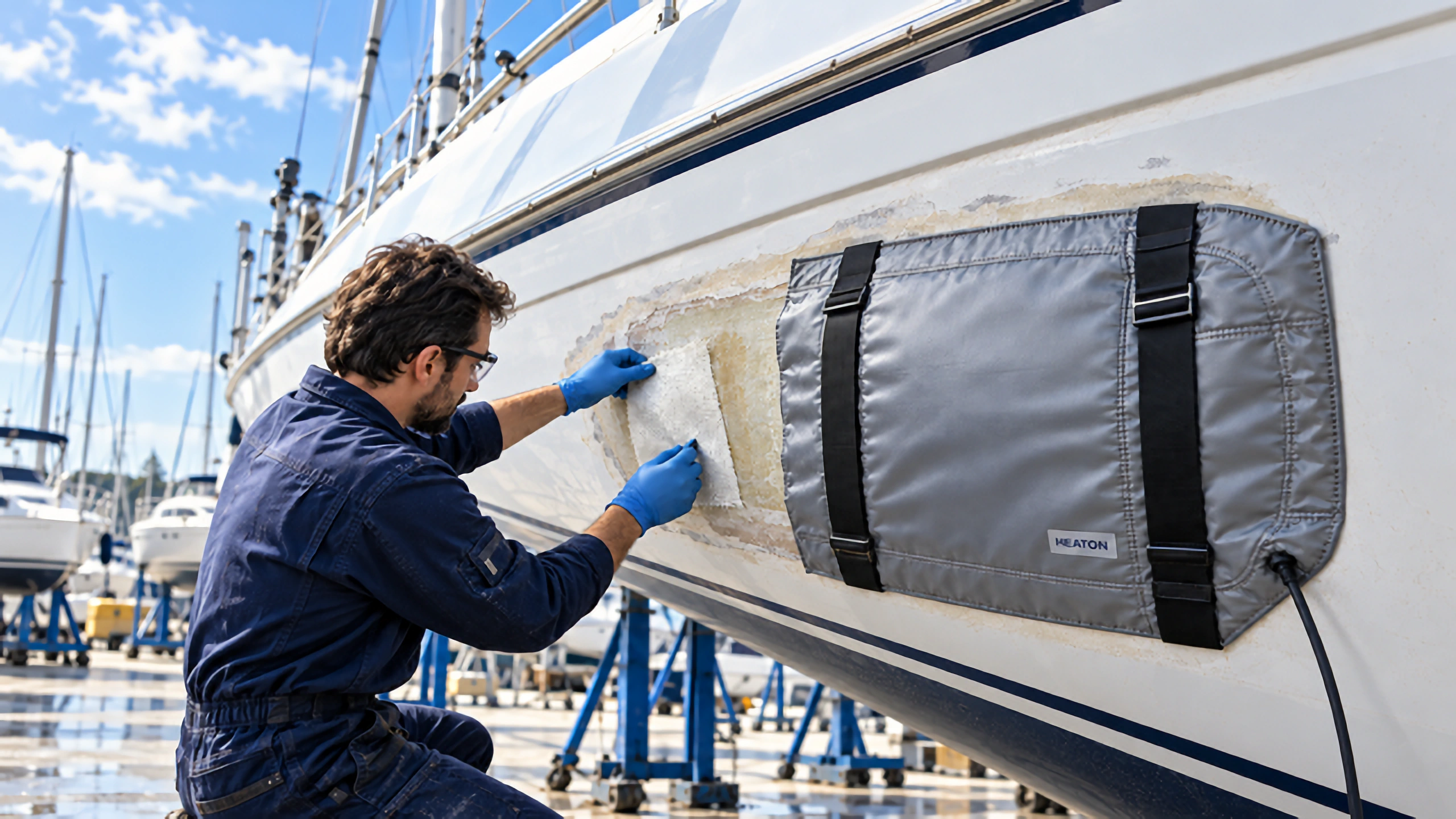
The repair of hulls, covers and components made of fiberglass or carbon fiber requires careful control of the temperature during the various processing stages. The preparation of the surfaces, the application of epoxy resins and the subsequent polymerization can require specific thermal conditions, defined according to the material and the intended cycle.
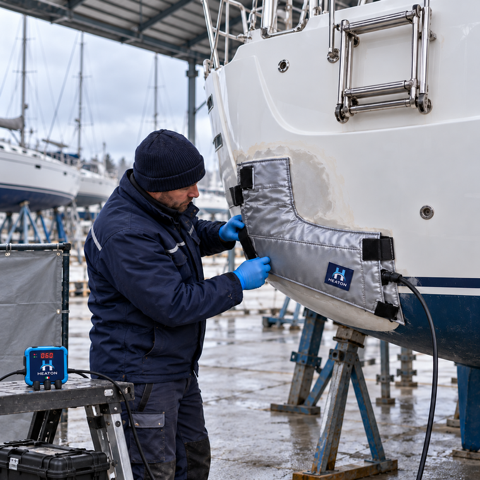
HeatOn develops flexible and controlled heating systems designed to adapt to the geometry of the area to be treated. The solutions can be used during repair, maintenance and restoration operations on composite material components, even directly on site.
The configuration is defined considering the material, the required temperature, the heat distribution and the operating conditions. The goal is to provide heating that is consistent with the requirements of the processing, with the possibility of controlling and maintaining the specified thermal parameters.
Fields of Application
- Repairs directly on site: solutions adaptable to the area of intervention and to environmental conditions, even when it is not possible to transfer the component to a heated environment.
- Glass-fiber frames: localized heating during repair and restoration work on the laminate.
- Frames and carbon fiber componentsTemperature control for composite material processing, in compliance with the limits of the resin-fiber system.
- Covers and nautical equipment: interventions on flat surfaces, curves or with articulated geometries.
- Epoxy resins and composite materials: support for the polymerization phases and any post-curing cycles planned by the process
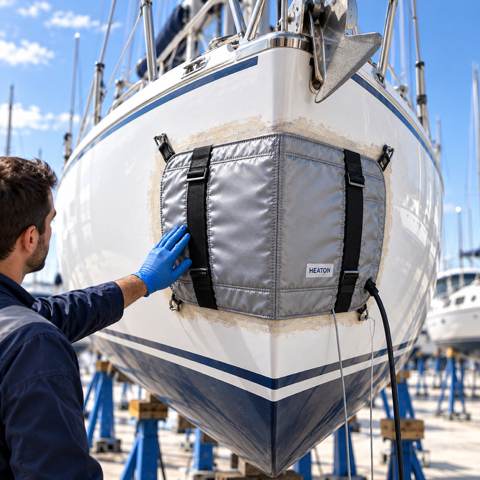
Warm up the area affected by the repair
When the resin level drops, the container’s thermal requirement changes. In a partially empty tank, keeping all heating zones active can lead to unnecessary heating of the upper areas.
HeatOn multi-zone configurations can be designed to separately manage different portions of the stem. For example, when the product is predominantly occupied by the lower part, it is possible to consider a configuration that allows the lower zone to be activated while the upper one is deactivated.
The arrangement of the zones, their power, and the position of the sensors must be determined based on the geometry of the container, the level of the material, and the thermal behavior of the product.
The operating advantage: Adapt the heating to the operating conditions, avoiding unnecessary heating of non-required areas and favoring a more targeted use of energy. The actual savings depend on the configuration, the material and the usage cycle.
Control of the polymerization temperature
The final performance of a composite repair also depends on compliance with the conditions required for the polymerization of the resin. Temperature, cycle duration, laminate thickness, and initial conditions can all influence the evolution of the process.
HeatOn can develop systems to apply and maintain the required heating during curing phases and, when required by the material manufacturer, after curing.
The system is sized considering the component’s mass, the geometry of the area to be heated, the thermal dissipation, and the technical specifications of the resin used.
The operational advantage: managing heating according to a defined cycle, avoiding relying solely on the ambient temperature or evaluations based solely on elapsed time.
Solution adapted to the geometry of the component
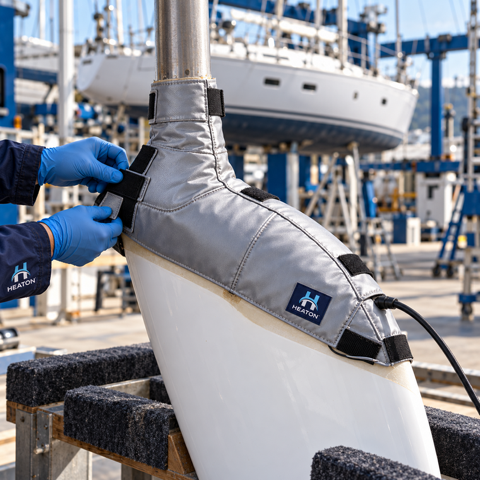
Sails, covers, panels and other nautical components have different geometries, with curvatures, changes in thickness and surfaces that can make it difficult to achieve an adequate thermal distribution with standard systems.
For this reason, HeatOn assesses the shape of the area to be treated, the size of the area affected, the material and the method of applying the heating system.
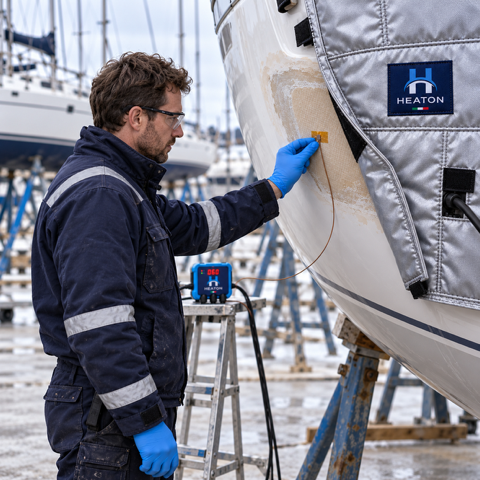
The configuration can be developed to adapt to the characteristics of the surface and the operational conditions of the intervention, also defining the positioning of the sensors necessary for temperature control.
The operational advantage: having a solution designed around the actual component and not just based on standard dimensions.
Heating for on-site interventions on the construction site
Repairing a system in an air-conditioned room or under stable environmental conditions is not always possible. On-board repairs in unheated warehouses or in areas exposed to climatic variations can make temperature management more complex.
A localized heating system allows an intervention to be evaluated directly on the affected area, taking into account the initial temperature of the component, the presence of air currents, and the dissipation into the environment.
Power, any necessary isolation, and control methods are defined based on the actual conditions of use.
The operational advantage: being able to evaluate a dedicated thermal solution even for interventions outside a controlled temperature production environment.
Control of heating according to process
During a repair, reaching a certain temperature is not always sufficient: it may be necessary to maintain it for a defined period and monitor the cycle’s progress.
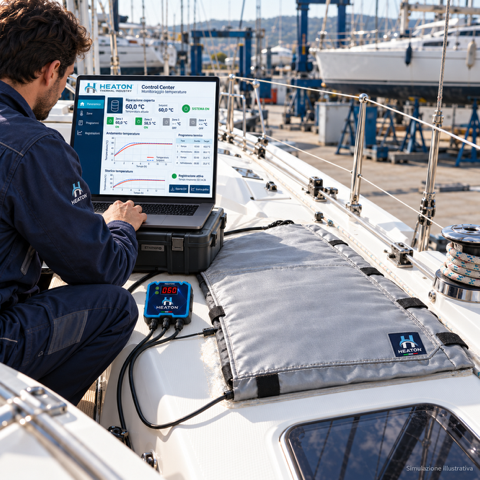
HeatOn can evaluate systems with temperature control via sensors and controllers, choosing the configuration based on the precision required and the characteristics of the application.
For processes that require more complex management, programmable controls can be considered, and, if provided for in the configuration, the monitoring and recording of thermal data.
The operational advantage: manage heating more controllably and, when necessary, have useful data to document the cycle performed.
💬 Tell us what you want to improve in your workshop
Do you want to have resins that are easier to remove at the beginning of the shift? Manage partially full tanks? Limit thermal dispersion or monitor the temperature during material preparation?
QUESTIONS AND ANSWERS FAQ
A: During a resin repair, the temperature of the component and the environment can affect the processing of the resins and the polymerization process. Controlled heating allows for the creation of the thermal conditions required by the repair cycle, promoting proper cross-linking of the material. HEATON systems allow for the application of heat directly to the affected area, without the need to necessarily heat the entire work environment.
A: It is possible to use localized heating systems designed to intervene exclusively on the surface affected by the repair. HEATON develops flexible solutions that can be adapted to the size and geometry of the area to be treated. This allows the thermal energy to be focused where it is needed, limiting heating of surrounding areas and dispersion into the environment.
A: There is no valid temperature for all repairs. The value depends on the resin used, the type of laminate, the component thickness, and the intended polymerization cycle. It is necessary to refer to the manufacturer’s technical specifications and to dimension the system based on the required conditions.
A: Flexible systems designed to adapt to curved surfaces and specific geometries can be evaluated. The configuration must take into account the component shape, the area to be heated, the application mode, and the positioning of the sensors. Feasibility must be verified based on the actual geometry and thermal requirements.
A: The time depends on the formulation of the resin, the actual temperature of the component, the thickness of the laminate, and the cycle specified by the manufacturer. Simply reaching the set temperature does not guarantee the completion of polymerization. To define the cycle, it is also necessary to consider the retention time and any subsequent steps that may be required.
A: Yes, it is possible to design solutions for interventions carried out directly on site, after evaluating the environmental and operational conditions. External temperature, wind, humidity, dispersion, and the availability of power supply can influence the result. The system must also be chosen based on the required protection and the safety conditions of the work area.
A: The possibility depends on the requirements of the thermal cycle and the configuration of the system. Fiberglass and carbon fiber can be used with different resins, thicknesses, and laminated structures. Before choosing the heating system, it is necessary to check the characteristics of the component and the specifications of the materials used.
A: The control can be achieved through sensors and controllers adapted to the application. The positioning of the sensors is important because the temperature of the heating surface may differ from that of the laminate or the area affected by the repair. For more complex cycles, programmable controls and data recording systems can be considered, if required.
A: For the configured configurations, it is possible to evaluate monitoring and recording systems for thermal parameters. To obtain useful data, it is necessary to define which temperatures to measure, where to place the sensors, and with what frequency to acquire the values. The recording capabilities depend on the selected control system and the documentation requirements of the process.
A: Yes. HEATON develops customized industrial heating solutions, also for nautical applications and composite materials. The project starts with the analysis of the surface to be treated, its dimensions and geometries, the materials used, and the required temperatures. Based on this information, the heating elements, their distribution, the sensors, and the control system that best suit the processing are defined.